


Leveling Up Student Storytelling at the National FFA Convention & Expo.
We paired student reporters with professional videographers to create a week-long immersive journalism experience.
The National FFA Convention & Expo is one of the largest youth gatherings in the country, bringing together more than 70,000 students, educators, and agriculture industry leaders for a week of competition, community, and connection.
With so much happening at once, capturing the energy and impact of the event requires a dedicated creative team that can move at the speed of breaking news.
That’s where INNOVATIVE comes in. For the third consecutive year, we partnered with Pence Media Group and the National FFA Organization to coordinate and manage the FFA LIVE! Newsroom. Together, we recruit a team of student reporters to capture the stories from convention, pairing them with professional videographers and editors to record broadcast-quality news packages that paint a vivid picture of the convention experience for the FFA members, supporters, and families who cannot attend in person.
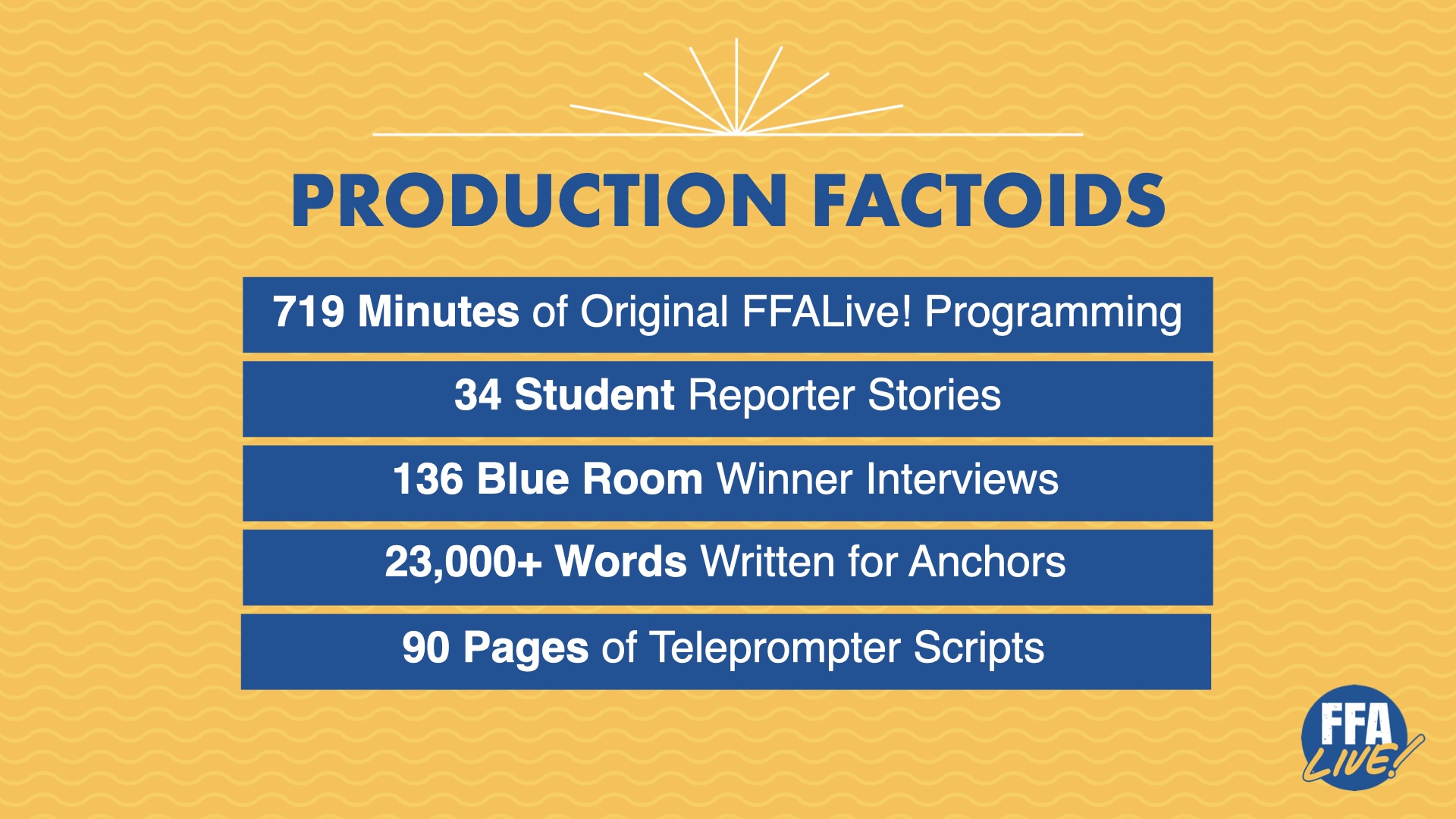
This year, we launched a new LIVE! studio show that served as the host of our 45-hour live stream broadcast.
Building on the success of previous years, we knew there was room to elevate FFA LIVE! to a whole new level. We looked to the best for inspiration, modeling our new live stream on the Olympics’ broadcast structure.
The idea was to create a live studio show that would serve as the hub of our convention coverage, recapping and summarizing the day’s news and then transitioning viewers between segments. So, we brought in two rising stars in the journalism world to serve as our anchors, giving these young professionals a chance to gain experience in a real-world broadcast setting.
Together, our anchors and our studio team worked long days, recording both live and live-to-tape to create a seamless live stream experience for our audience.
But we didn’t stop there. We also introduced two brand-new interview segments: The Blue Room and Desk Chats.


The Blue Room was our backstage interview room positioned right off the main convention stage.
As winners were announced and walked off stage, two of our student reporters were ready to capture their immediate reactions and celebrate their achievements. Over the course of the week, we conducted more than 130 interviews in The Blue Room—each one made available publicly for families and local news outlets to celebrate their hometown heroes.
Meanwhile, our Desk Chats were a mixture of live and pre-recorded interview segments hosted by our two anchors exclusively for the studio show.
While many of these conversations happened right at the FFA LIVE! anchor desk, we also took the anchors out to the Expo floor to interview sponsors near their booths, giving them experience in both studio and field production environments.
Coordinating a production this complex requires a master schedule we call the “Production Bible.”
With student reporters filming stories with videographers, anchors conducting Desk Chats, live shows airing daily, and The Blue Room capturing back-to-back interviews, keeping everything organized was no small feat. That’s why we created what our team affectionately calls the “Production Bible,” a comprehensive production schedule that organizes the complex, interconnected puzzle and every moving piece.
This master document ensures that every interview gets scheduled around stage programming, every person knows where they need to be, and every story has time to be edited and aired. While it’s not glamorous to look at, it’s the kind of behind-the-scenes work that makes a production of this scale run smoothly—even when things inevitably go off-script.

Pairing students with professionals creates an incredibly impactful week-long internship experience.
One of the most unique and rewarding aspects of this program is the mentorship model. By pairing student reporters and anchors with professional videographers, editors, and producers, we create an immersive learning environment where students can see real growth in their skillsets over just a few days.
Throughout the week, students learn how to craft compelling interview questions, deliver polished on-camera performances, and think on their feet when live television demands it. They work alongside industry professionals who guide them through every step—from pre-production planning to final edits—giving them hands-on experience that better prepares them for future careers in media and communication.
For many of these students, this is their first time working in a professional production environment. And by the end of the week, they’re conducting interviews with confidence, anchoring live shows, and telling stories that capture the heart of the FFA experience. That kind of transformation is what makes this partnership so special.
